Wander Where the Walls Whisper Stories: A Stroll Through Meknes’ Soul
Walking through Meknes feels like flipping through the pages of a living history book—each alleyway a sentence, every doorway a paragraph. This isn’t just Morocco’s fourth imperial city; it’s a mosaic of forgotten rhythms and daily magic. I wandered without maps and found charm in chaos: spice-scented lanes, artisans hammering copper, and locals who smile like old friends. Come see why getting lost here is the best plan you’ll never make.
The Heartbeat of Imperial Morocco: Why Meknes Stands Apart
Meknes occupies a unique place among Morocco’s four imperial cities—Marrakech, Fes, Rabat, and itself—offering a rare balance between regal heritage and unpretentious daily life. Unlike the bustling intensity of Fes or the polished tourist appeal of Marrakech, Meknes unfolds at a gentler pace, where history isn’t preserved behind velvet ropes but lives in the rhythm of footsteps on ancient stone. Designated a UNESCO World Heritage site in 1996, its medina is celebrated for its monumental gates, intact city walls, and urban layout that reflects the ambitions of 17th-century Sultan Moulay Ismail, who envisioned it as the grandest capital in North Africa.
What sets Meknes apart is its authenticity. While other historic cities have adapted heavily to tourism, Meknes retains a strong sense of local identity. You won’t find souvenir shops on every corner or crowds crowding photo spots at dawn. Instead, life continues as it has for generations—children rush to school through arched passages, vendors unload crates of fruit before sunrise, and elders gather in shaded plazas for quiet conversation. This isn’t a city performing for visitors; it’s one simply being itself, inviting you to observe, listen, and absorb.
The city’s most iconic landmark, Bab Mansour, stands as a testament to its imperial past. Completed in 1732, this vast gate is considered one of the most beautiful in North Africa, with its intricate zellij tilework, towering white columns, and inscriptions from the Quran. It marks the entrance to the imperial city and serves as a daily thoroughfare for locals, blending sacred artistry with practical use. This duality—where grandeur and utility coexist—is central to Meknes’ character, making it ideal for travelers seeking depth over spectacle.
Stepping Into the Medina: Where Time Slows Down
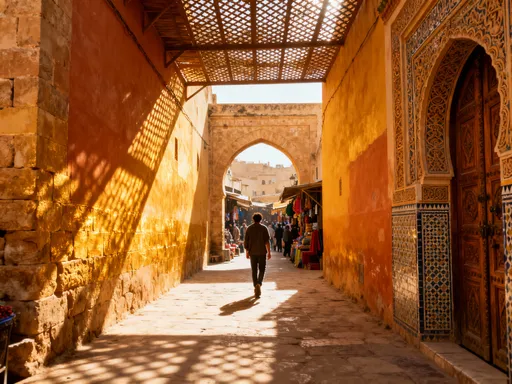
Entering the medina of Meknes is like crossing a threshold into another dimension. One moment you're on a wide, modern street with motorbikes weaving through traffic; the next, you're beneath a stone archway, surrounded by the hush of narrow alleys where sunlight filters through laundry lines strung between rooftops. The sensory shift is immediate—the hum of engines gives way to the rhythmic clang of metalworkers, the call to prayer echoing from minarets, and the soft shuffle of slippers on worn cobblestones.
The medina’s layout is intentionally disorienting, a maze designed centuries ago for defense and community privacy. Today, that same complexity rewards the aimless wanderer. Without a map, you might stumble upon a small mosque with a hand-painted wooden door, a courtyard where jasmine spills over a fountain, or a hidden bakery where the scent of baking bread wraps around you like a warm embrace. These moments aren’t staged for tourists—they happen quietly, continuously, as part of the city’s daily breath.
What makes the Meknes medina particularly special is its lack of commercial saturation. Unlike other Moroccan medinas where every storefront caters to visitors, here the shops serve residents first. You’ll pass a spice vendor weighing cumin and saffron for a grandmother in a headscarf, a tailor threading a needle by hand, or a man selling brooms made of dried palm fronds. The authenticity of these interactions creates a sense of intimacy, as if you’ve been granted a quiet glimpse into a world that doesn’t need to perform for you to be valuable.
Even the architecture tells a story of endurance. The walls, built from local stone and plaster, bear the marks of time—chipped edges, faded paint, patches of moss in shaded corners. Yet they stand firm, holding up wooden balconies and carved lintels that speak of craftsmanship passed down through generations. Walking these lanes, you begin to understand that history in Meknes isn’t something you read about—it’s something you feel underfoot, in the cool shade of an arch, in the glance of a woman watching from her window.
Exploring the Souks: Commerce with Character
The souks of Meknes are not marketplaces in the modern retail sense—they are living arteries of community life. Covered passageways, some vaulted with brick and others open to the sky, wind through the medina, each dedicated to a particular trade. The air hums with the low murmur of negotiation, the clink of scales, and the occasional burst of laughter from a group of neighbors catching up while shopping.
In the spice alleys, pyramids of turmeric, paprika, and ginger glow like jewels in woven baskets. Vendors sit cross-legged beside their wares, offering small tastes of ras el hanout or a pinch of saffron to rub between your fingers. Unlike in more tourist-heavy cities, there’s no pressure to buy—just a quiet invitation to engage. Prices are fair, often quoted in a matter-of-fact tone, and bargaining, when it happens, feels like a gentle dance rather than a contest of wills.
Further in, the leather quarter releases its distinctive scent—a mix of tannins, oils, and drying hides. Artisans work with tools that look centuries old, cutting, stamping, and polishing leather for bags, slippers, and belts. Nearby, metalworkers shape copper and brass into lanterns and teapots, their hammers striking a steady, hypnotic rhythm. These crafts aren’t performed for show; they are livelihoods sustained by local demand and the occasional visitor who appreciates handmade quality.
One of the most heartening aspects of Meknes’ souks is the presence of food vendors serving the community. A stall might specialize in olives—green, black, cured in lemon and cumin—sold by the kilo to housewives filling their cloth bags. Another simmers snail soup in large pots, a regional specialty served in small bowls with a sprig of fresh mint. These are not attractions; they are necessities, woven into the fabric of daily survival and celebration alike.
The Rym Gardens and Heri es-Souani: Grandeur in Ruins
Just beyond the medina lies one of Meknes’ most astonishing legacies: the vast complex of Heri es-Souani, built by Sultan Moulay Ismail as part of his grand imperial vision. What remains today is a breathtaking ensemble of vaulted stables, granaries, and underground cisterns, stretching over hectares of land. The stables alone were designed to house 12,000 horses, a testament to the sultan’s military ambitions and engineering foresight. Walking through the arched chambers, you can still feel the coolness of the thick stone walls and imagine the echo of hooves on packed earth.
The granaries, elevated on stone pillars to prevent moisture, once stored enough grain to feed the entire army for years. The cisterns—long, rectangular pools covered by vaulted ceilings with small openings for light—held millions of liters of water, collected from nearby mountains through an intricate system of aqueducts. These structures weren’t just functional; they were symbols of power, meant to impress both allies and enemies with the sultan’s ability to command resources on a massive scale.
Today, these ruins are not fenced off or turned into sterile museums. They are open, accessible, and often filled with local visitors—families strolling through the arches, children playing hide-and-seek among the pillars, couples sitting by the edge of the cisterns sharing quiet moments. This integration of history into daily life is what makes Meknes so special: the past isn’t preserved behind glass—it’s lived in, walked through, enjoyed.
Adjacent to Heri es-Souani lies the Agdal Basin, a large rectangular pool originally used for irrigation and ceremonial boat rides. Now, it’s surrounded by the Rym Gardens, a peaceful green space where families picnic under olive and palm trees. In the evenings, the area comes alive with walkers, joggers, and vendors selling mint tea and roasted sunflower seeds. The contrast between the monumental ruins and the relaxed park life is striking, yet harmonious—a reminder that even the grandest ambitions eventually settle into the rhythm of ordinary happiness.
Local Life Beyond the Monuments: Neighborhoods That Breathe
While the medina and imperial sites draw visitors, the true soul of Meknes lives in its residential quarters—neighborhoods like Quartier Lamkansa, Haddada, and Bourg Tazi. These areas, just a short walk from the historic center, offer unfiltered glimpses into Moroccan family life. Here, life unfolds in open squares, shared courtyards, and narrow lanes where laundry flutters like prayer flags above cobblestone paths.
In the late afternoon, you’ll see children kicking footballs in dusty plazas, using backpacks as goalposts. Elders gather under the shade of plane trees, sipping mint tea from small glasses, their conversations punctuated by bursts of laughter. Women return from the market with bundles of vegetables and fresh bread, balancing packages on their heads with effortless grace. These scenes aren’t curated for cameras—they happen naturally, consistently, forming the quiet poetry of daily existence.
One of the most touching traditions is the neighborhood bakery, or *four*. Each morning and evening, women bring dough from home to be baked in communal wood-fired ovens. The process is a social ritual as much as a culinary one—neighbors chat while waiting, sharing news and recipes, their voices rising above the crackle of the fire. When the bread emerges—golden, crisp, and fragrant—it’s wrapped in cloth and carried home, often still warm.
These neighborhoods also reveal the resilience and warmth of Meknes’ people. Homes may be modest, with chipped paint and iron gates, but they are cared for, adorned with potted plants, hand-painted tiles, or small fountains. Doors are often left ajar, inviting conversation. Strangers greet each other with a nod or a soft “salam alaikum,” and visitors, even foreign ones, are often met with curiosity rather than suspicion. It’s a city where community isn’t an ideal—it’s a fact of life.
From Street Food to Home Flavors: Tasting Meknes One Bite at a Time
To taste Meknes is to understand its heart. The city’s culinary culture is deeply rooted in home cooking, seasonal ingredients, and slow preparation. While restaurants exist, the most memorable meals are often found on street corners, in tiny stalls, or shared with locals who insist you join them for tea.
Breakfast might begin with *msemen*—flaky, buttery flatbreads cooked on a griddle and served with honey or olive oil. Nearby, a vendor might offer *bissara*, a thick soup made from fava beans, garlic, and cumin, traditionally eaten with a drizzle of olive oil and a sprinkle of paprika. It’s humble food, nourishing and deeply flavorful, often enjoyed from a clay bowl while standing at a counter.
For lunch, *kefta tagine*—spiced ground meat in a tomato and egg sauce—is a favorite, slow-cooked in a conical clay pot and served with bread for scooping. You’ll find it in small family-run eateries where tables are simple and the hospitality is rich. Another local specialty is *rfissa*, a dish of shredded msemen served with lentils, chicken, and fenugreek, often prepared for celebrations like births or religious holidays.
Street food near Bab el-Khemis market is especially vibrant on Thursdays, when farmers and artisans gather. Grilled meats sizzle on open flames, releasing smoky aromas that draw crowds. Vendors serve skewers of lamb or chicken with a side of harissa and fresh bread. Seasonal fruits—plump figs, juicy pomegranates, almonds from nearby orchards—are sold by weight, their sweetness a reward after hours of walking.
But more than the food itself, it’s the culture around eating that leaves an impression. Meals in Meknes are not rushed. They stretch over hours, accompanied by stories, silence, and shared warmth. Strangers often end up at the same table, exchanging smiles over a pot of mint tea. In this city, food isn’t just sustenance—it’s connection, memory, and love made visible.
Practical Magic: How to Wander Meknes Like a Local
To truly experience Meknes, approach it not as a checklist of sights but as a rhythm to match. The best times to walk are early morning, when the city wakes slowly, and late afternoon, when shadows lengthen and families emerge for evening strolls. Avoid midday heat, especially in summer, and carry a reusable water bottle—hydration is essential on uneven cobblestones.
Footwear matters. Choose comfortable, closed-toe shoes with good grip; the streets are uneven, and some alleys are slick after rain. Dress respectfully—light, loose clothing that covers shoulders and knees is ideal. While Meknes is welcoming, modesty shows respect for local customs.
Begin your exploration at Bab Mansour, then move into Place el-Hedim, the lively square that serves as the medina’s heartbeat. From there, let curiosity guide you. Don’t worry about getting lost—there are no dead ends, only discoveries. Safe areas for solo walking include the main souk lanes, the path to Heri es-Souani, and the Agdal Gardens.
Carry small change—coins and low-denomination notes—for chai breaks, small purchases, or tips. A 5 or 10 dirham note can buy a glass of mint tea from a street vendor or a small bag of roasted almonds. Don’t rush interactions; a shared tea can lead to a conversation, and a conversation can become a memory.
Finally, embrace spontaneity. Say yes to an invitation for tea. Follow a child’s laughter down an alley. Sit by a fountain and watch the world pass. Meknes rewards those who slow down, who listen more than they speak, who understand that the richest experiences aren’t found in guidebooks but in the quiet moments between.
Why Getting Lost Here Feels Like Finding Something Real
Meknes doesn’t demand attention. It doesn’t dazzle with neon lights or promise once-in-a-lifetime thrills. Instead, it offers something rarer: the chance to move through a city that feels genuinely lived-in, where history isn’t a performance but a presence. Every cracked tile, every hand-hammered lantern, every shared smile carries the weight of centuries, yet feels immediate, alive.
To wander Meknes is to practice a different kind of travel—one rooted in observation, patience, and connection. It’s about stepping off the path of curated experiences and into the flow of real life. Here, you’re not a spectator but a witness, invited to see how people live, cook, pray, and laugh in a city that honors its past without being trapped by it.
In a world where destinations are increasingly shaped by algorithms and Instagram trends, Meknes stands as a quiet rebellion. It asks nothing of you except your presence. It gives back a sense of wonder that comes not from spectacle, but from sincerity. So come without a map. Let the walls whisper their stories. And discover, as so many have, that sometimes the most meaningful journeys are the ones that don’t lead you anywhere in particular—only deeper into what’s real.